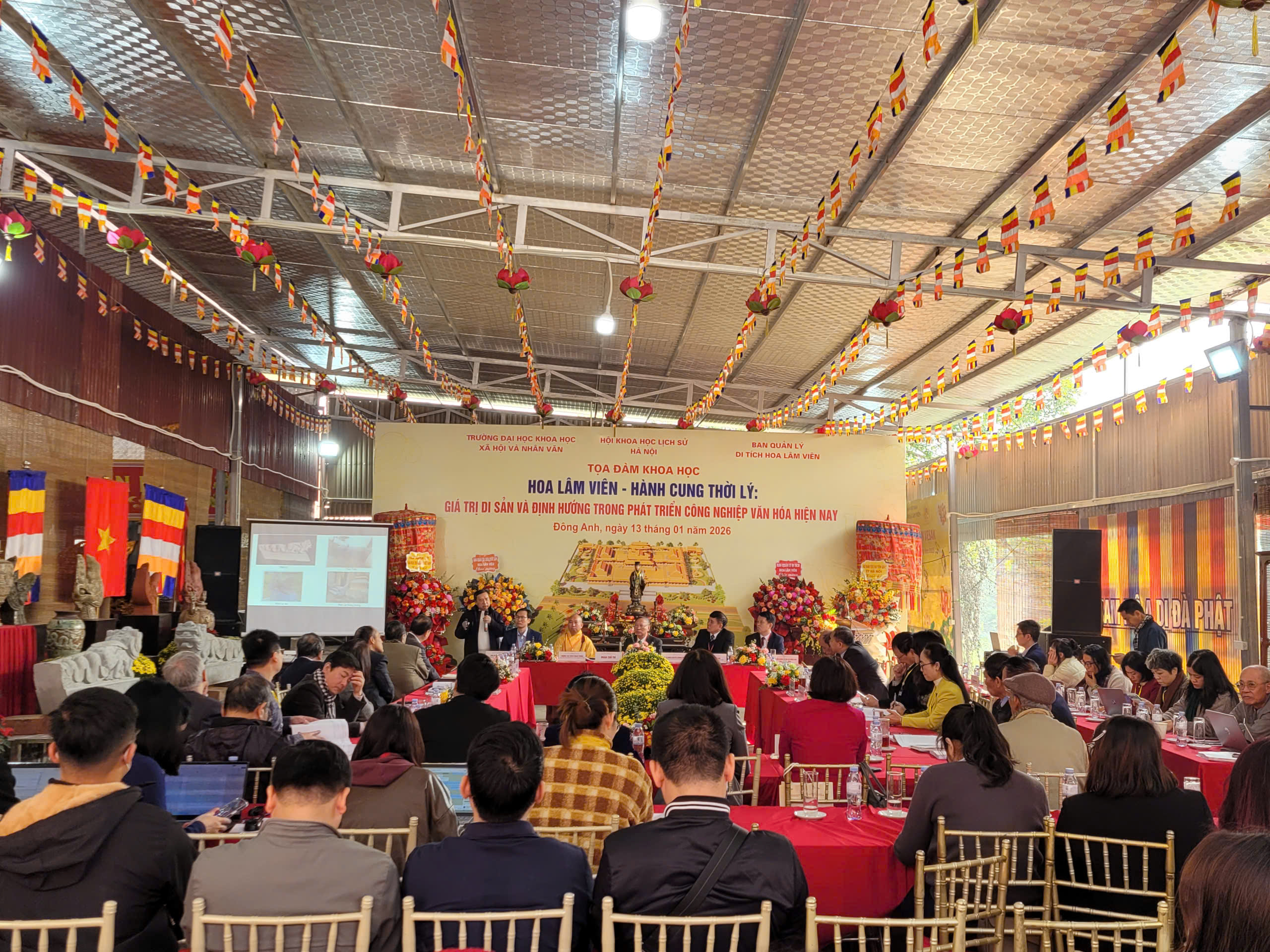
On January 13, 2026, at the Hoa Lâm Viên relic site (Đông Anh Commune, Hà Nội City), the University of Social Sciences and Humanities (VNU), the Hà Nội Historical Science Association, and the Hoa Lâm Viên Relic Site Management Board jointly organized the scientific workshop entitled “Hoa Lâm Viên – A Lý Dynasty Imperial Residence: Heritage Values and Orientations for Contemporary Cultural Industry Development.”
The workshop was held in the context of the country moving toward the 14th National Congress of the Communist Party of Việt Nam, while also responding to the urgent need to identify, preserve, and promote cultural heritage values associated with sustainable development, particularly the development of cultural industries in the Capital city of Hà Nội.

The setting of the scientific workshop “Hoa Lâm Viên – A Lý Dynasty Imperial Residence: Heritage Values and Orientations for Contemporary Cultural Industry Development”
Hoa Lâm Viên – A special imperial residence of the Lý Dynasty
In his opening remarks, Dr. Nguyễn Văn Sơn, Chairman of the Hà Nội Historical Science Association, emphasized that Hoa Lâm Viên was not only a representative imperial residence of the Lý Dynasty but also a space closely associated with the homeland and origins of the Lý royal family, holding a particularly important position in the history of the formation and development of the Đại Việt state.
With heritage values and development orientations as its central theme, the workshop aimed to comprehensively clarify issues related to the Hoa Lâm Viên space, the Lý Dynasty imperial residence system, its relationship with Cổ Loa – the Thăng Long Imperial Citadel – the Red River cultural axis, as well as the potential for this heritage site to directly participate in the socio-economic and cultural industry development process of the Capital.
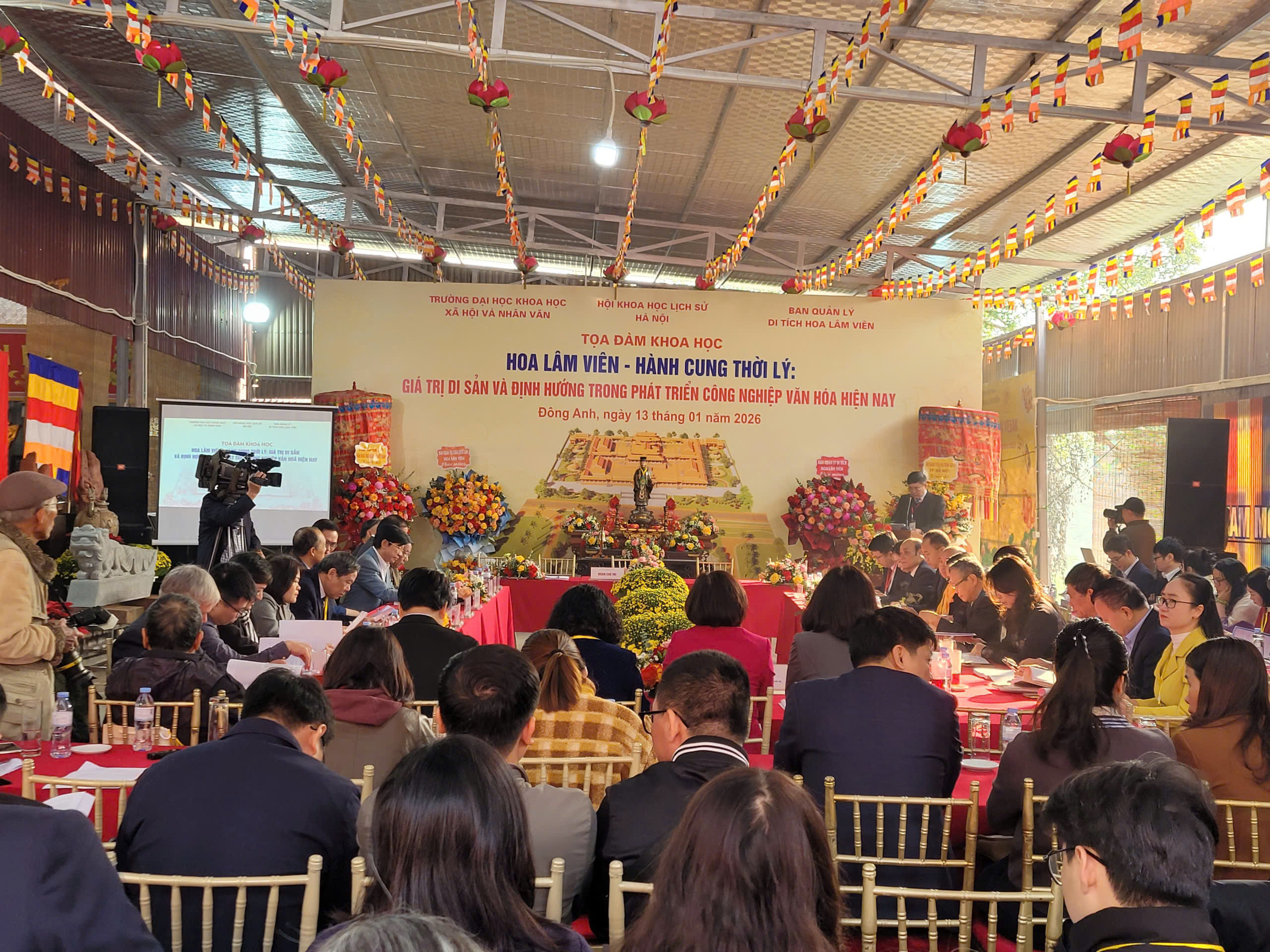 Dr. Nguyễn Văn Sơn, Chairman of the Hà Nội Historical Science Association, delivers the opening remarks.
Distinctive historical, cultural, and ideological values
According to the Organizing Committee, the workshop received 22 papers from scholars across various disciplines, including History, Archaeology, Geography, Architecture, Hán-Nôm Studies, Cultural Heritage, and Cultural Management.
The papers were divided into three main thematic groups, with particular emphasis on the group focusing on promoting the value of the Hoa Lâm Viên Imperial Residence heritage within the cultural space north of the Red River, closely linked to practical issues of heritage management, conservation, and value exploitation.
Scholars pointed out that Hoa Lâm Viên was not merely a royal architectural structure, but also a space for ancestor worship of the Lý Dynasty, clearly reflecting the political ideology and moral philosophy characteristic of the Lý era, where Buddhism combined with indigenous filial traditions to establish the legitimacy of royal power.
Many studies also clarified the broad geo-cultural space of Hoa Lâm Viên, situating the site within the heritage network of Đông Anh – north of the Red River, closely connected with the Cổ Loa Relic Site, the Thăng Long Imperial Citadel, and ancient transportation and cultural routes, particularly the Thiên Đức River (the Đuống River).
Connecting Cổ Loa and Hoa Lâm Viên in cultural tourism development
One topic receiving significant attention was the potential to connect Hoa Lâm Viên with the Cổ Loa Relic Site to form a continuous heritage space, contributing to the development of distinctive historical and cultural tourism in the Đông Anh area.
 M.A., PhD candidate Nguyễn Hồng Chi, Deputy Director of the Thăng Long – Hà Nội Heritage Conservation Center, presents a paper on orientations and solutions for promoting the value of the Hoa Lâm Viên imperial residence heritage and the Cổ Loa Citadel.
According to scholars, although Cổ Loa—the early power center of the Âu Lạc state—and Hoa Lâm Viên—the imperial residence associated with the homeland of the Lý Dynasty—belong to different historical periods, they share continuity in space, history, and cultural memory. Connecting these two sites would not only enhance the overall value of each heritage site but also facilitate the development of thematic tourism routes such as:
* “From Cổ Loa to Hoa Lâm Viên – A Journey through Ancient Power Centers”
* “The Cultural Space North of the Red River across Dynasties”
Through linked tourism routes and sites, visitors can approach history in a systematic manner, from the era of nation-building to the period of an independent Đại Việt state, while expanding their experiences to include heritage education, archaeological visits, local cultural experiences, and cultural industry products.
The workshop reached a consensus that promoting the value of Hoa Lâm Viên heritage must be placed within an overall cultural and tourism development strategy for the Đông Anh area, in which the connection with the Cổ Loa Relic Site plays a central role.
Hoa Lâm Viên is identified as a hub connecting the historical memory of the Lý Dynasty, while Cổ Loa represents the core historical and cultural space of the nation-building period. This linkage provides a foundation for developing in-depth cultural tourism products, avoiding fragmentation and overlap, and moving toward sustainable development. The application of digital technology, the creation of experiential spaces, heritage interpretation, tour-route connectivity, and the active participation of local communities are considered key solutions for transforming heritage values into development resources, contributing to the cultural industries and socio-economic development of Hà Nội.
Drawing on a rich and multidimensional body of papers, the scientific workshop not only clarified the historical and cultural values of the relic site but also opened new approaches to heritage conservation, promotion, and connectivity—particularly highlighting the relationship between Hoa Lâm Viên, Cổ Loa, and Thăng Long in the Capital’s cultural, tourism, and cultural industry development strategy.