In ancient times, Cổ Loa Village had four wards: Đông Nhất, Đông Nhì, Đông Tam, and Đoài Tự. Each year, every ward selected one elder to “stand for appointment” as the Cụ Từ (Quan Đám) – the person who represented the community in performing rituals throughout the year and who oversaw and safeguarded the temple dedicated to King An Dương Vương and the Mỵ Châu shrine. The tradition of Khất keo for selecting the Temple Custodian follows strict customary rules as below:
- Election (nomination) of the Festival Officers (Thủ từ):
Carried out in the early days of the twelfth lunar month, this process takes considerable time because candidates must be economically stable, have complete families, be free from mourning obligations, possess good moral character, and have no physical deformities. In Cổ Loa Village, there are 12 hamlets divided into three groups: Nhồi Trên, Nhồi Dưới, Gà, Dõng; Vang, Hương, Thượng, Bãi; Chợ, Chùa, Mít, Lan Trì.
Each year, four hamlets nominate four representatives—called trùm giáp—to participate in selecting the Festival Officers (Quan đám), who serve for a one-year term (after three years, it returns to the same hamlet group). Before the August Revolution, Cổ Loa had up to 28 giáp; among people of the same age group, not everyone could become the head of a giáp. Each giáp chose one person from those of the same age cohort, following the order registered in the giáp ledger. However, the top-listed candidate must not be in mourning or have any deformity in that selection year. If he was, the role would pass to the second or third in line, and so on. Each year, based on this rotation, the person at the top of the ledger at age 59 would be selected as trùm giáp. At the end of their 58th year, these trùm giáp were chosen to go to the Upper Temple (đền Thượng) to perform the “Kất keo” ritual—casting two coins to ask the deity for permission to serve as Festival Officer, responsible for incense offerings to the king. The selection proceeded from larger hamlets to smaller ones, choosing three Festival Officers to oversee the rituals at the Upper Temple, the Mỵ Châu Shrine, and the Thạch Temple (Ngự Xạ Đài). The hamlet representative was chosen from one of the hamlet’s lineages, selected carefully according to strict local customs. Beneath the three Festival Officers were 8 or 6 assistants, appointed by 8 or 6 giáp, who were responsible for festival and ritual activities at the Upper Temple.
After the festival was restored in 1990, the basic customs were maintained, but the selection method changed. The Commune People’s Committee and the Fatherland Front now oversee the process. After each village nominates 3–4 elders aged 55–70, the authorities, together with the Elderly Association, hold a meeting to vote. The two candidates with the highest votes become Festival Officers. The main criteria remain: complete families, no mourning, and no involvement in social vices.
- The “Khất keo” ritual: Performed in the early twelfth lunar month, the four trùm giáp selected from four hamlets bring offerings to the Upper Temple, conducting the “Khất keo” ritual to ask the deity for permission to serve as Festival Officers (formerly called Thủ từ or Cai đám). The same process occurs at the Mỵ Châu Shrine and the Ngự Xạ Đài Temple. The term of a Festival Officer lasts one year, from the 14th day of the twelfth lunar month of the previous year to the 14th day of the twelfth lunar month of the next year.
Today, the “Khất keo” ritual has been replaced by a secret ballot: the two candidates with the highest votes are selected—one serves at the temple, and the other at the shrine.
- The “Nhập tịch” ritual (now called the handover ceremony of Festival Officers): Held annually on the 14th day of the twelfth lunar month. This is regarded as a celebratory day for the three lineages whose representatives are chosen as Festival Officers. The ceremony is conducted with great solemnity. Before the ceremony, families prepare offerings and personal items for the incoming Festival Officer. On the day itself, the family and lineage host a feast. Early in the morning, dressed in formal attire, the family and descendants first perform rituals at the hamlet shrine, then proceed to the Upper Temple for the nhập tịch ceremony. After completing the ritual, they continue to the Mỵ Châu Shrine, the communal house, and Ngự Xạ Đài Temple. For Festival Officers serving at the shrine or Ngự Xạ Đài, they must first attend the ritual at the Upper Temple before performing the handover at their designated site.
During the procession, if they pass any hamlet shrine, they must stop to offer ritual respects. On this day, the Festival Officer recites the Mục lục prayer at the temple, praising the virtues of the deities and praying for peace for the village.
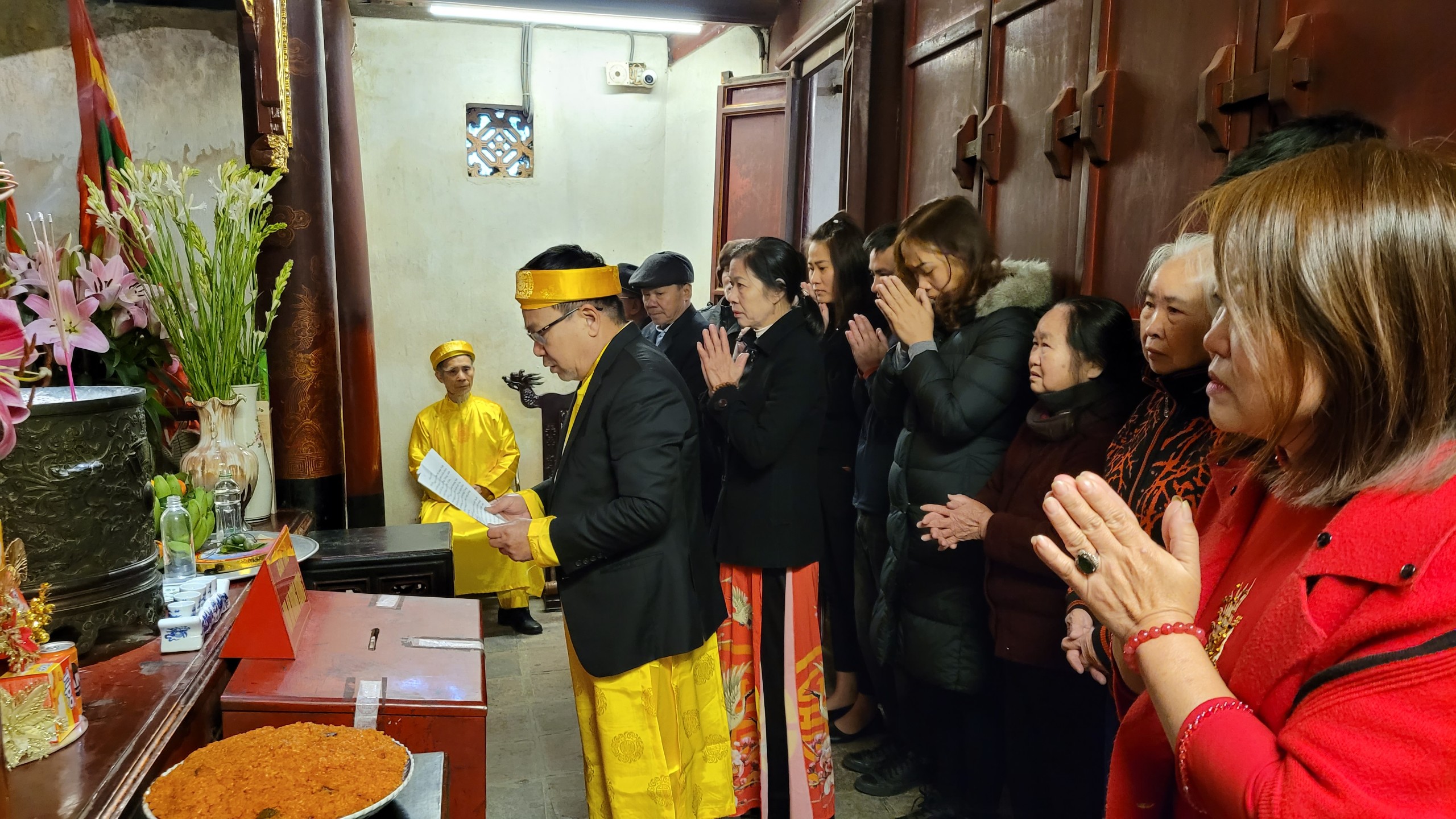
The Festival Officer recites the ritual text during the nhập tịch ceremony
Since 1995, when the Cổ Loa Site was transferred to the Hanoi Relics Management Unit, and later in 2006 to the Thăng Long Heritage Conservation Center, the nhập tịch ritual has been renamed the handover and reception ceremony of Festival Officers, chaired by the Party Committee, Commune People’s Committee, and Fatherland Front of Cổ Loa. The officers are then handed over to the managing unit—the Cổ Loa Relic Site Management Board.
- The “Vinh quy bái tổ” ritual: After being installed as Festival Officers at the temple and shrine on the 14th day of the twelfth lunar month, they remain there to fulfill their duties throughout the Cổ Loa Festival. On the 20th day of the first lunar month, they may return home for one day to report to their ancestors and lineage—this is known as the “Vinh quy bái tổ” ritual.
The Khất keo ritual is an ancient tradition of the former imperial citadel region and a distinctive cultural custom of the local people. It continues to be preserved, upheld, and passed down through generations in this historic land.